Module 1 quiz
| 1 | According to MuleSoft, what is the Center for Enablement's role in the new IT operating model?
|
| 2 | What is a core characteristic of the Modern API?
|
| 3 | What HTTP method in a RESTful web service is typically used to completely replace an existing resource?
|
| 4 | What MuleSoft API-led connectivity layer is intended to expose part of a backend database without business logic?
|
| 5 | Refer to the exhibit. The API specification supports searching for articles on the searchworld.org site. What is the most idiomatic (used for its intended purpose) URL and method to retrieve articles about "einstein" in XML format?
|
| 6 | What statement is part of MuleSoft's description of an application network?
|
Module 2 quiz
| 1 | A web client submits a GET request to a Mule 4 application to the endpoint /customers?id=48493. Where is the id stored in the Mule event by the HTTP Listener?
|
| 2 | What MuleSoft product enables publishing, sharing, and searching of APIs?
|
|
| 4 | Where does a deployed Flow Designer application run in Anypoint Platform?
|
| 5 | What asset can NOT be created using Design Center?
|
Module 3 quiz
| 1 | A RAML example fragment named BankAccountsExample.raml is placed in the examples folder in an API specification project. What is the correct syntax to reference the fragment?
|
| 2 | Refer to the exhibit. What is the correct URL to submit a GET request to /patients?
|
| 3 | Refer to the exhibit. There is an error in the flight_id resource's GET method. What needs to be done to fix the problem?
|
| 4 | Refer to the exhibit. This RAML specification includes an XML example that matches the Records data type defined in another RAML file named recordsDataType.raml. Using the Records type, how can this XML example be represented in RAML?
|
| 5 | An API has been created in Design Center. What is the next step to make the API discoverable?
|
Module 4 quiz
| 1 | What is the minimum required configuration in a flow for a Mule application to compile?
|
| 2 | What is NOT part of a Mule 4 event?
|
| 3 | What is the purpose of the api:router element in APIkit?
|
| 4 | How does APIkit determine the number of flows to generate from a RAML specification?
|
| 5 | A Database connector is configured to select rows from a MySQL database. What is the format of the array of results returned from the database query?
|
Module 5 quiz
| 1 | API Manager has been configured to enforce an SLA policy and the RAML spec has been updated with the required client_id and client_secret header requirements. The new RAML spec has been published to Anypoint Exchange. What is the next step to gain access to the API?
|
| 2 | What is the purpose of API autodiscovery?
|
| 3 | What does an API proxy application NOT do?
|
| 4 | How many Mule applications can run on a CloudHub worker?
|
| 5 | What does the Mule runtime use to enforce policies and limit access to APIs?
|
Module 6 quiz
| 1 | What is NOT part of a Mule 4 event?
|
| 2 | A flow contains an HTTP Listener as the event source. What is the DataWeave expression to log the Content-Type header using a Logger component?
|
| 3 | A Mule application has two flows named parentFlow and childFlow. The childFlow begins with an HTTP Listener. A variable is defined in parentFlow, then an HTTP Request is made to childFlow's HTTP Listener with some headers set. What is the scope of the variable and attributes in the parentFlow after childFlow returns a response?
|
| 4 | Refer to the exhibit. What is the correct DataWeave expression for accessing the city Cleveland from the JSON payload?
|
| 5 | A web service implements an API to handle requests to http://acme.com/customers/{state}. A web client makes a request to this API implementation at http://acme.com/customers/CA. What is the correct DataWeave expression to retrieve the value CA?
|
| 6 | What happens to the attributes of a Mule event in a flow after an outbound HTTP Request is made?
|
| 7 | A Mule application has a flow named parentFlow. The parentFlow contains an HTTP Request operation at the end of the flow. The parentFlow also contains a Set Variable operation right before the HTTP Request operation. What is the scope of the variable to the server receiving the HTTP Request from parentFlow?
|
| 8 | A Set Variable component saves the current payload to a variable with the name images. What is the DataWeave expression to access the images variable?
|
Module 7 quiz
| 1 | What reserved property can be defined and used in a Mule application to allow an HTTPS Listener to be accessed by external web clients after the Mule application is deployed to CloudHub?
|
| 2 | What can ONLY be done with VM connectors, and NOT with Flow References, in a single Mule application?
|
| 3 | Refer to the exhibit. In the deployable archive's /classes folder, there are two properties files named dev.properties and prod.properties. The Mule application fails to deploy to CloudHub through Runtime Manager with the following error message. What could be causing this error?
|
| 4 | Why must a Mule application's deployable archive package all its dependencies in order to be deployed to CloudHub?
|
| 5 | In what file does the Mule project keep track of all of its dependencies?
|
| 6 | A Mule application has two flows named parentFlow and childFlow. A variable is defined in parentFlow. What is the scope of the variable when the parentFlow calls childFlow using a Flow Reference?
|
Module 8 quiz
| 1 | How are query parameters dynamically passed to an outbound REST request using an HTTP Request operation?
|
| 2 | An HTTP Request operation returns a JSON array of objects. In the Transform Message component, what is the process to convert the array of objects to an array of custom Java Account objects?
|
| 3 | Refer to the exhibit. The flow calls a SOAP endpoint using the Consume operation of the Web Service Consumer. The SOAP service has a required input parameter. What event processor can be used to build the SOAP envelope with the required argument to pass to the SOAP service?
|
| 4 | What is the process to create a connector using REST Connect?
|
| 5 | What file type is required to configure a Web Service Consumer to consume a SOAP web service?
|
Module 9 quiz
| 1 | An event contains a payload that is an Array of Objects. How is the event routed in a Scatter-Gather?
|
| 2 | What module and operation will throw an error if a Mule event's payload is not a number?
|
| 3 | A Scatter-Gather processes three separate HTTP requests. Each request returns a Mule event with a JSON payload. What is the final output of the Scatter-Gather?
|
| 4 | How are multiple conditions used in a Choice router to route events?
|
| 5 | Refer to the exhibits. What happens to this flow when the Validation module's Is not null operation throws an error?
|
Module 10 quiz
| 1 | Refer to the exhibits. The main flow has an On Error Continue scope and the private flow has an On Error Propagate scope. A web client makes an HTTP GET request to the HTTP Listener. The Is number validator in the private flow then throws an error with message "Validate - Payload is an Integer". What response message is returned to the web client?
|
| 2 | How can an error scope be configured to catch all errors in the HTTP namespace?
|
| 3 | Refer to the exhibits. The main flow has an On Error Continue scope. In the Configuration global element, default error handler is set to globalErrorHandler. A web client makes an HTTP GET request to the flow's HTTP Listener. The Is number validator then throws an error with message "Validate - Payload is an Integer". What response message is returned to the web client?
|
| 4 | Refer to the exhibits. The private flow has an On Error Propagate scope. In the Configuration global element, default error handler is set to globalErrorHandler. A web client makes an HTTP GET request to the flow's HTTP Listener. The Is number validator in the private flow then throws an error with message "Validate - Payload is an Integer". What response message is returned to the web client?
|
| 5 | Refer to the exhibits. The main flow has an On Error Propagate scope. In the Configuration global element, default error handler is set to globalErrorHandler. A web client makes an HTTP GET request to the flow's HTTP Listener. The Is number validator then throws an error with message "Validate - Payload is an Integer". What response message is returned to the web client?
|
| 6 | Refer to the exhibits. The main flow has an On Error Continue scope with type set to HTTP:NOT_FOUND. The Mule application configures globalErrorHandler as its default error handler. A web client posts a request to the HTTP Listener. The Transform Message component then throws a MULE:EXPRESSION error trying to convert the payload to application/xml. What response message is returned to the web client?
|
Module 11 quiz
| 1 | What is the correct way to format the decimal 20.3844 as a string to two decimal places?
|
| 2 | Refer to the exhibit. An event payload contains an unordered array of flight objects, where every object has a price key and a toAirport key. What is valid DataWeave code to return flights with price under 500, grouped by toAirport in ascending order, with the lowest price first?
|
| 3 | A Mule application has a main flow and a combineNames flow. In the main flow, a variable named fullName is set to the object {firstName: "Max", lastName: "Mule"}. What is valid DataWeave code to call the combineNames flow with the input object stored in the fullName variable?
|
| 4 | Refer to the exhibit. What is valid DataWeave code to transform the input JSON payload to the output XML payload?
|
| 5 | What DataWeave 2.0 type can be used as input to a map operation?
|
Module 12 quiz
| 1 | Refer to the exhibit. What is the object type returned by the File List operation?
|
| 2 | In the Database On Table Row operation, what does the Watermark column enable the On Table Row operation to do?
|
| 3 | A flow has a JMS Publish consume operation followed by a JMS Publish operation. Both of these operations have the default configurations. Which operation is asynchronous (does not wait for a response before continuing to the next event processor) and which operation is synchronous (blocks and waits for a response or timeout before continuing to the next event processor)?
|
| 4 | A Flow Reference component sends a non-empty JSON object payload to another flow named childFlow, which then returns an XML body. A Flow Reference component saves the payload returned from childFlow to its target attribute named payload. Refer to the exhibit. What is true about the Mule event's payload at the next event processor after the Flow Reference component?
|
| 5 | Assume that a database table contains a recordID column that always increases as new records get added to the table. In a Mule application, what is the key process to enable manual watermarking for requests to a database using the Scheduler endpoint and the Database SELECT operation?
|
Module 13 quiz
| 1 | Refer to the exhibits. The Set Payload component sets the payload to a Map object (not an Array). The File Write operation writes out files based on this Map object. How many files are written to the file system when the flow executes?
|
| 2 | Refer to the exhibit. What are the values of the counter and stepVar variables after the Batch Job?
|
| 3 | Refer to the exhibit. What are the values of the counter and stepVar variables in the On Complete phase?
|
| 4 | Refer to the exhibit. The payload [1,2,3] is passed to the Batch Job scope. In Batch_Step_1, a variable named batchStepPayload is set to the current payload. What is the value of the last log message after one batch job completes?
|
| 5 | A Batch Job scope has three batch steps. An event processor in the second batch step throws an error because the input data is incomplete. What is the default behavior of the batch job after the error is thrown?
|
| 6 | Refer to the exhibits. What is the output of the Logger component in the Batch Job?
|
1. Refer to the exhibit.
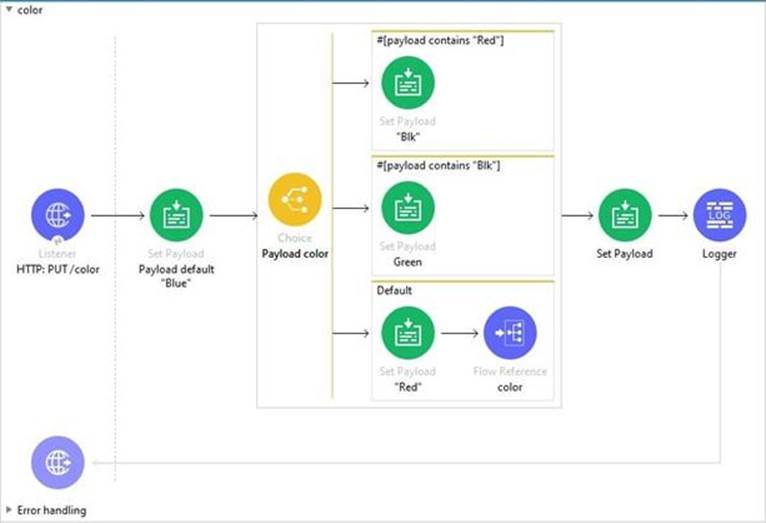
The default scope in choice router recursively calls the color flow.
A web client sends a PUT request to the HTTP listener with payload Blue.
What response is returned to the web client?
2. What MuleSoft product enables publishing, sharing, and searching of APIs?
3. An app team is developing a mobile banking app. It took them two months to create their own APIs to access transaction information from a central database. The app team later found out that another team had already built an API that accesses the transaction information they need.
According to MuleSoft, what organization structure could have saved the app team two months of development time?
4. According to MuleSoft, what is the Center for Enablement’s role in the new IT operating model?
5. How we can scale deployed Mule application vertically on cloudhub?
6. An API has been created in Design Center .
What is the next step to make the API discoverable?
7. An API implementation has been deployed to CloudHub and now needs to be governed. IT will not allocate additional vCore for a new Mule application to act as an API proxy.
What is the next step to preseive the current vCore usage, but still allow the Mule application to be managed by API Manager?
8. An organization is beginning to follow Mulesoft's recommended API led connectivity approach to use modern API to support the development and lifecycle of the integration solutions and to close the IT delivery gap.
What distinguishes between how modern API's are organized in a MuleSoft recommended API-led connectivity approach as compared to other common enterprise integration solutions?
9. A Mule application contains two HTTP Listeners, each configured for different API endpoints: http://acme.com/apis/orders and http: //acme .com/a pis/customers.
What base path value should be set in an HTT? Listener config element so that it can be used to configure both HTTP Listeners?
10. A flow needs to combine and return data from two different data sources. It contains a Database SELECT operation followed by an HTTP Request operation.
What is the method to capture both payloads so the payload from the second request does not overwrite that from the first?
11. Refer to the exhibit.
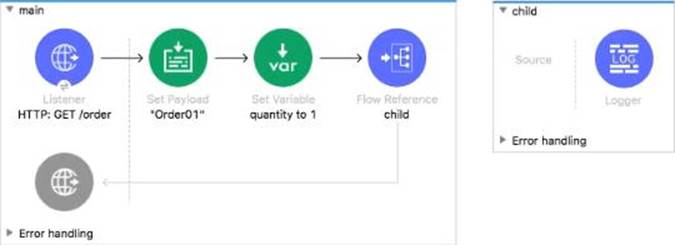
The main flow contains a Flow Reference for the child flow.
What values are accessible in the child flow after a web client submits a request to http://localhost:8Q81/order? color=red?
12. What payload is returned by a Database SELECT operation that does not match any rows in the database?
13. What module and operation will throw an error if a Mule events payload is not number ?
14. What is the difference between a subflow and a sync flow?
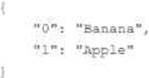
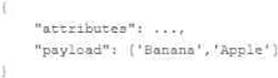
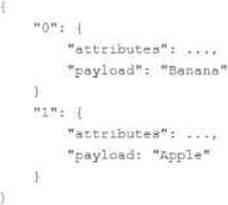
15. Refer to the exhibits.
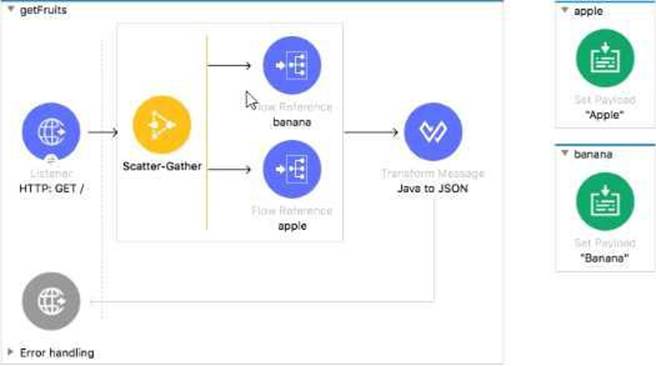
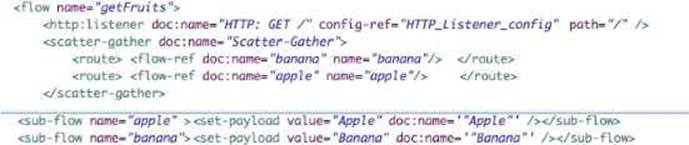
A web client submits a request to http://localhQst:8081 .
What is the structure of the payload at the end of the flow?
A)

B)
C)
D )
16. A company has an API to manage departments, with each department identified by a unique deptld. The API was built with RAML according to MuleSoft best practices.
What is valid RAML to specify a method to update the details for a specific department?
A)
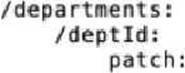
B)
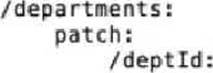
C)
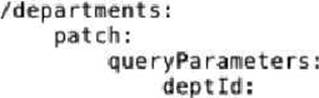
D)
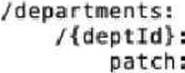
17. Refer to the exhibits.
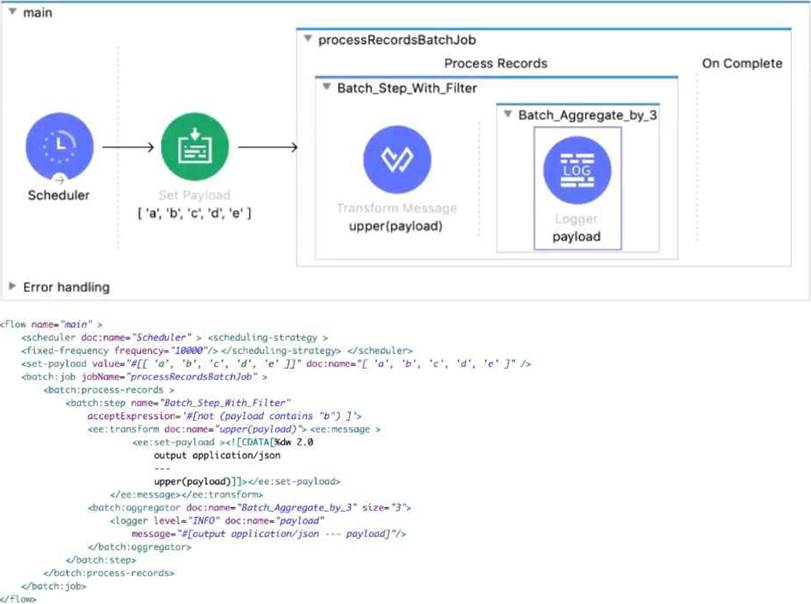
The input array of strings is processed by the batch job that processes, filters, and aggregates the values .
What is the last message logged by the Logger component after the batch job completes processing?
18. What is minimal requirement in a flow for a Mule application to compile?
19. A web client submits a request to http://localhost:8081?accountType=personal. The query parameter is captured using a Set Variable transformer to a variable named accountType.
What is the correct DataWeave expression to log accountType?
20. How can you call a subflow from Dataweave?
21. Refer to the exhibits.
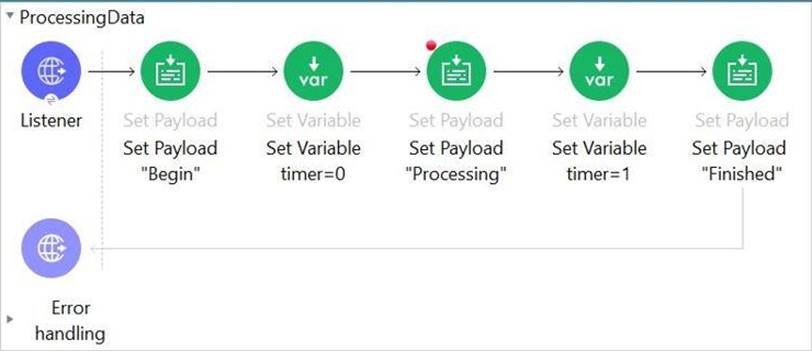
The Mule Application is being debugged in Anypoint Studio and stops at breakpoint .
What is the value of payload displayed in debugger at this breakpoint?
22. From which application, Organization Administrators can approve/revoke/delete SLA tier access requests
23. Refer to the exhibit.
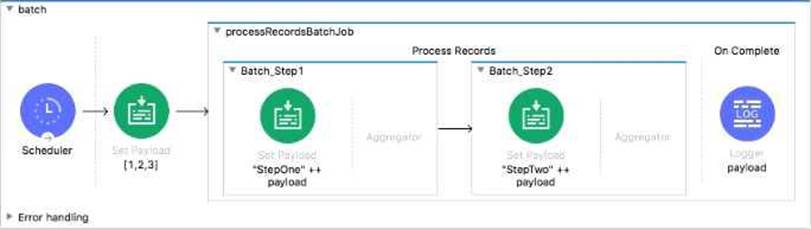
What is the output payload in the On Complete phase
24. A function named newProdCode needs to be defined that accepts two input parameters, an integer value for itemID and a string value for productCategory, and returns a new product code.
What is the correct DataWeave code to define the newProdCode function?
25. Refer to the exhibits.
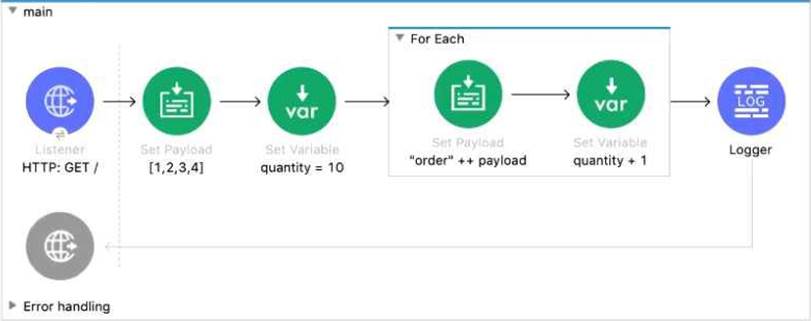
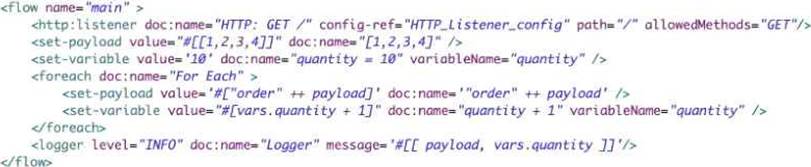
What payload and quantity are logged at the end of the main flow?
26. Which keyword do you use to create a new function in DataWeave?
27. Refer to the exhibits.
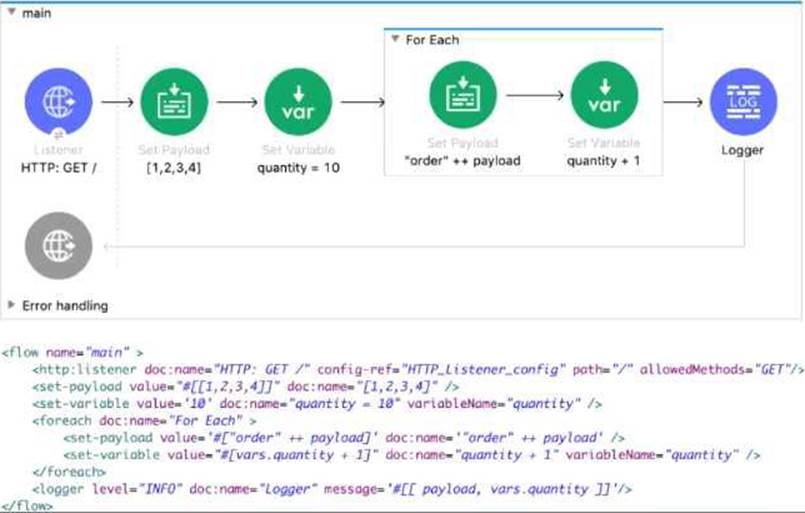
What payload and quantity are togged at the end of the main flow?
28. host: " localhost"
29. A Batch Job scope has five batch steps. An event processor throws an error in the second batch step because the input data is incomplete .
What is the default behavior of the batch job after the error is thrown?
30. What is not the function of API Gateway ?
31. How many Mule applications can run on a CloudHub worker?
32. A Mule flow has three Set Variable transformers .
What global data structure can be used to access the variables?
33. What DataWeave expression transforms the example XML input to the CSV output?
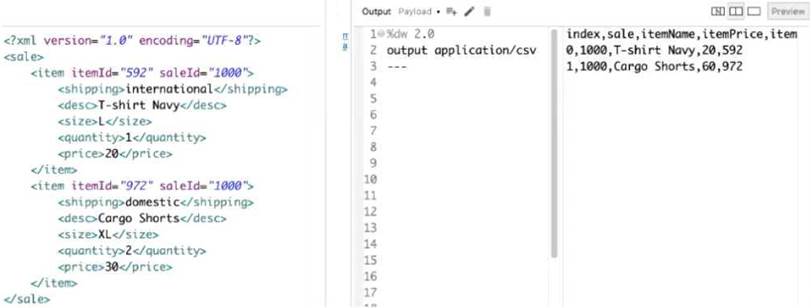
A)
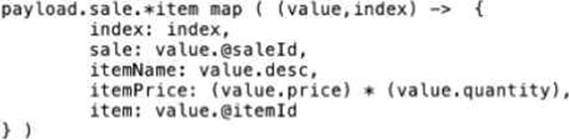
B)
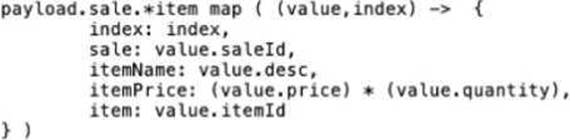
C)
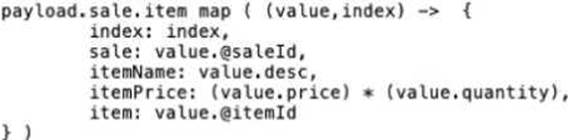
D)
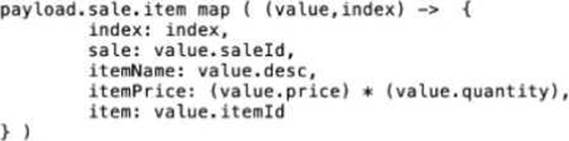
34. Refer to the exhibit.
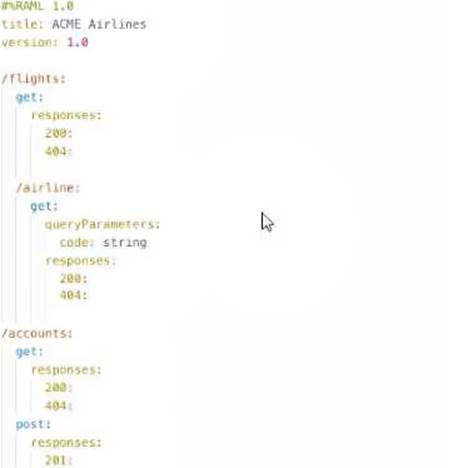
How many private flows does APIKIT generate from the RAML specification?
35. Why would a Mule application use the ${http.port} property placeholder for its HTTP Listener port when it is deployed to CloudHub?
36. Refer to the exhibit.
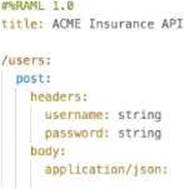
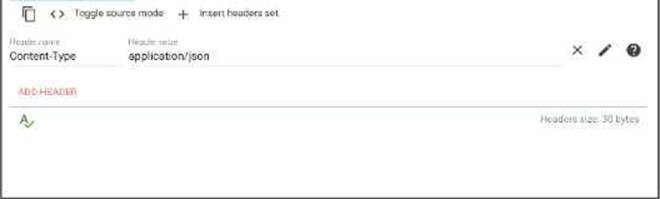
What is the correct way to create a user?
A)
B)
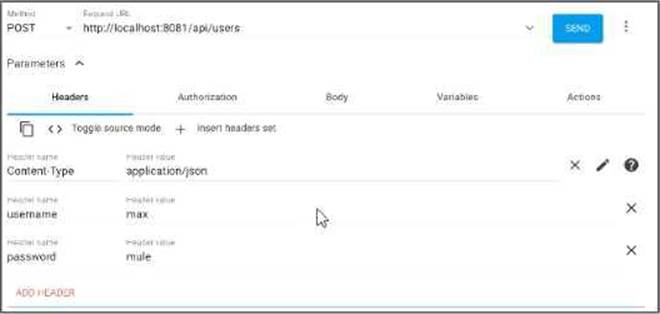
C)
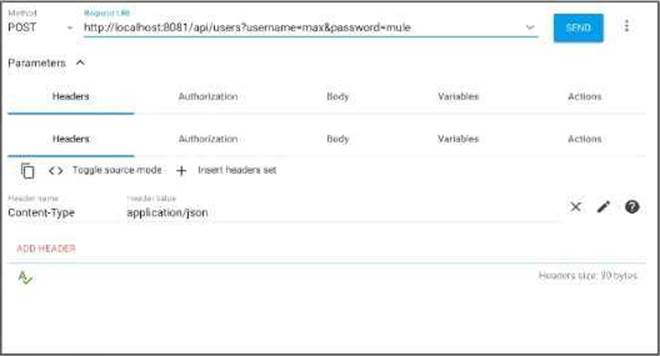
D)
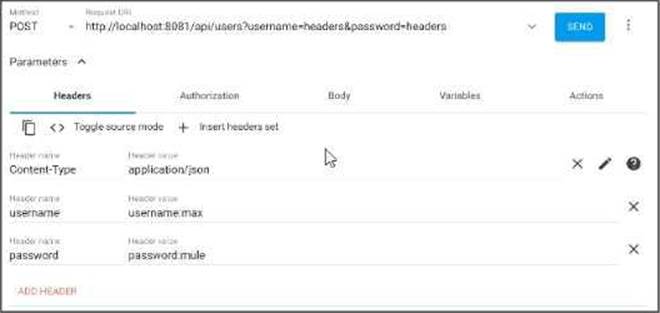
37. Where is metadata stored in a Mule project
38. Refer to the exhibit.
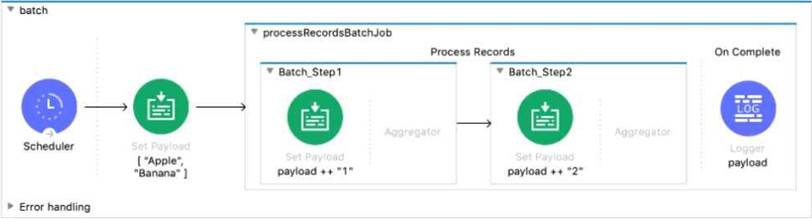
The input array of strings is passed to the batch job, which does NOT do any filtering or aggregating .
What payload is logged by the Logger component?
39. A Mule application configured with Autodiscovery implements an API.
Where is governance enforced for policies defined for this Mule application?
40. What does C4E stands for in MuleSoft recommended IT operating model?
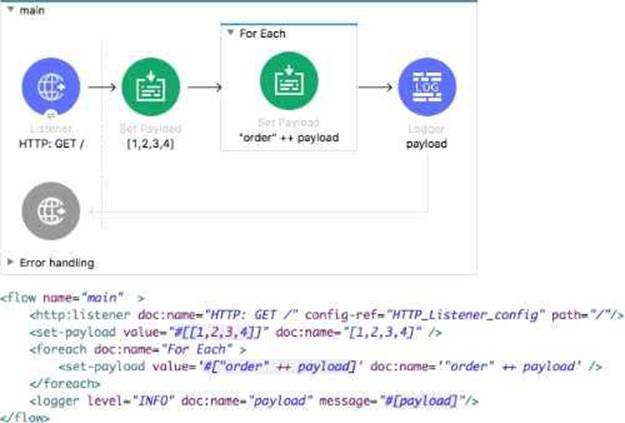
41. Refer to the exhibits .
What payload is logged at the end of the main flow?
42. According to Mulesoft, how are Modern APIs treated as?
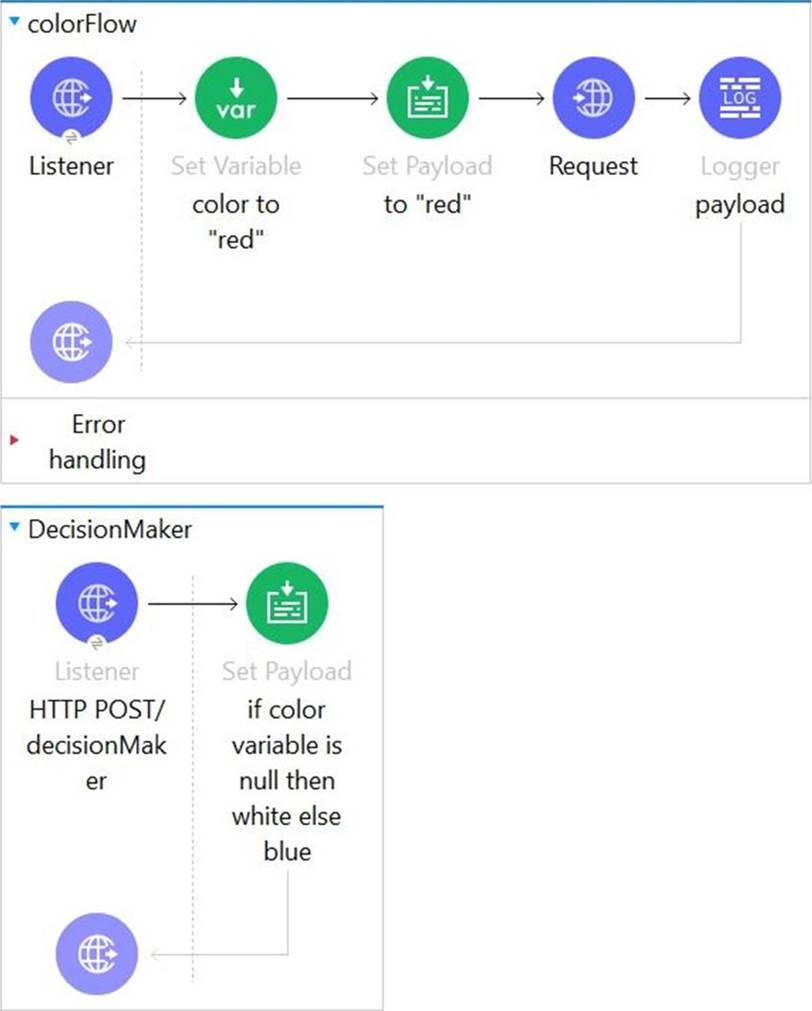
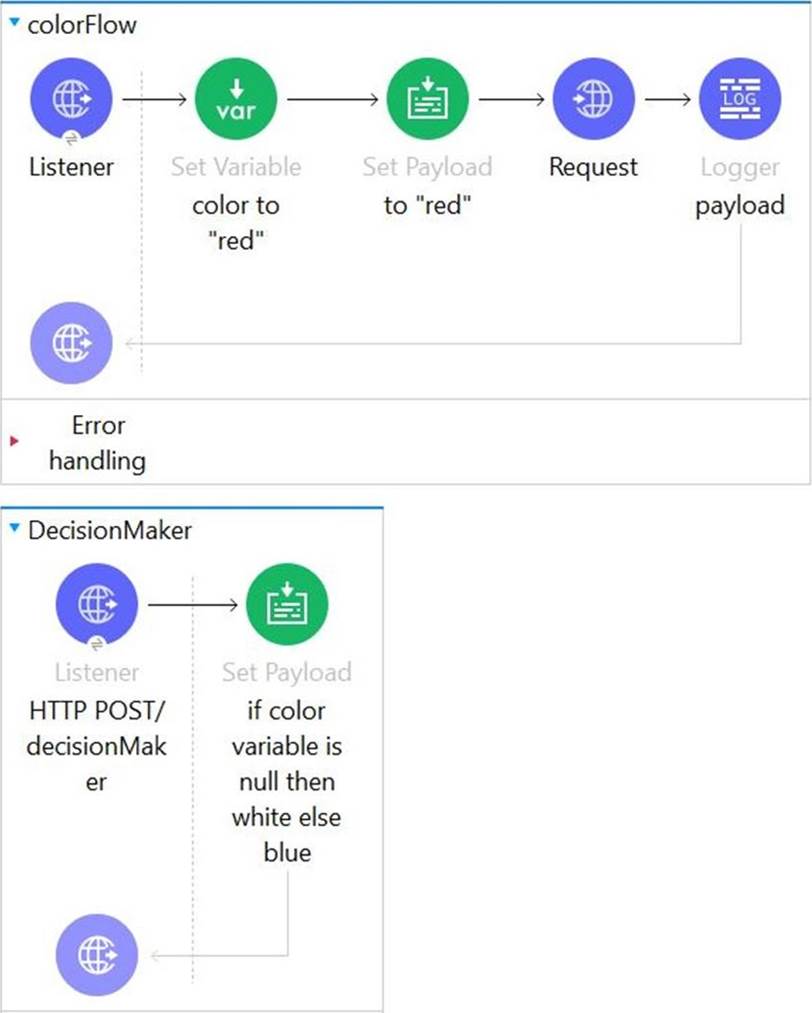
43. Refer to the exhibits. In the color flow, both the variable named color and payload are set to "red".
An HTTP POST request is then sent to the decideColor flow's HTTP Listener.
What is the payload value at the Logger component after the HTTP request completes?

44. Refer to exhibits.
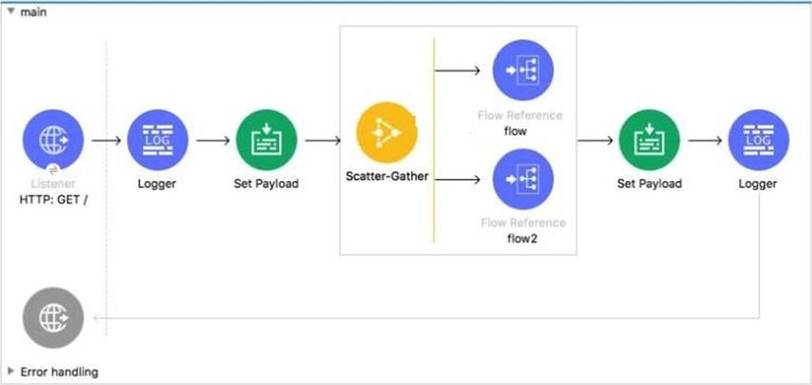
In the execution of the Scatter-Gather, the flow route completes after 10 seconds and the flow2 route completes in 40 seconds .
How many seconds does it take for the Scatter-Gather to complete?
45. According to MuleSoft. what is the first step to create a Modern API?
46. Which of the below activity doesn't support parallel execution?
47. A Mule application contains an ActiveMQ JMS dependency. The Mule application was developed in Anypoint Studio and runs successfully in Anypoint Studio.
The Mule application must now be exported from Anypoint Studio and shared with another developer.
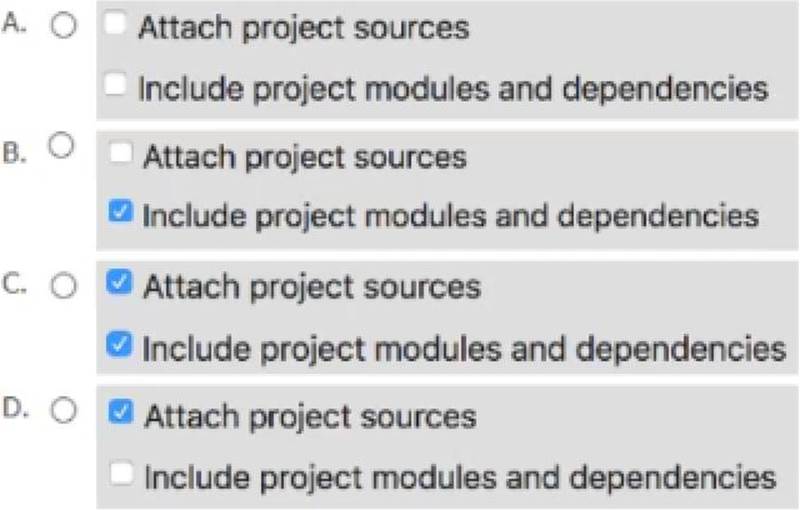
What export options create the smallest JAR file that can be imported into the other developer's Anypoint Studio and run successfully?
48. Which of the module is imported automatically in Dataweave scripts?
49. Refer to the exhibits.
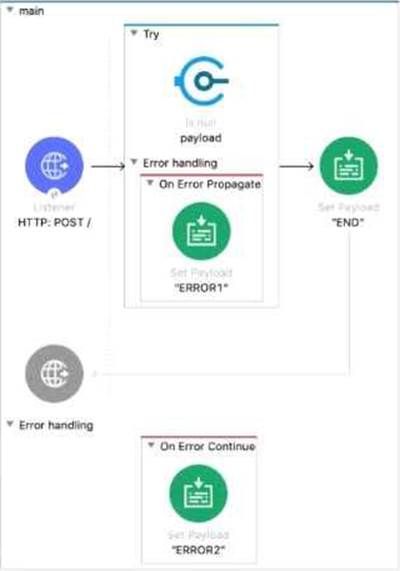
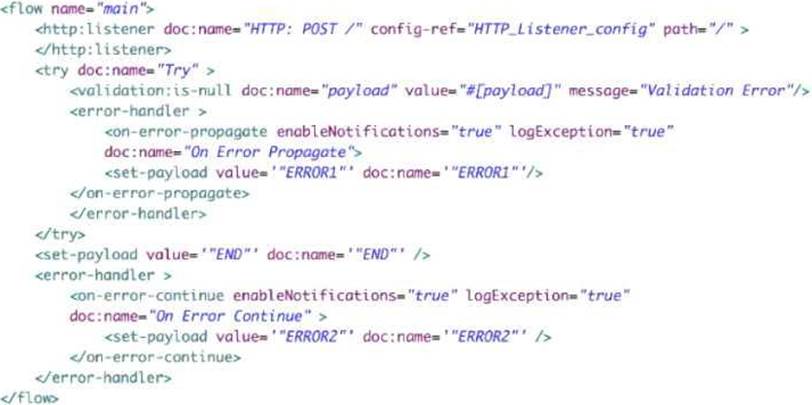
A web client sends a POST request to the HTTP Listener and the Validation component in the Try scope throws an error.
What response message is returned to the web client?
50. Refer to the exhibits.
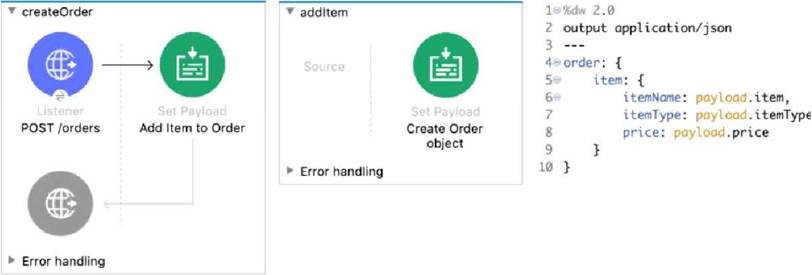
The Set Payload transformer in the addltem child flow uses DataWeave to create an order object.
What is the correct DataWeave code for the Set Payload transformer in the createOrder flow to use the addltem child flow to add a router call with the price of 100 to the order?
51. Refer to the exhibit.
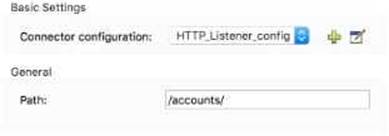
What is the correct syntax to add an employee ID as a URI parameter in an HTTP Listener path?
52. Refer to the exhibits.
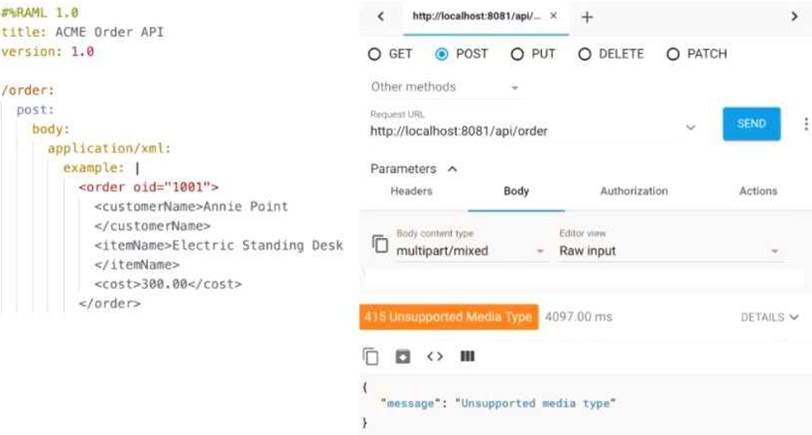
The web client sends a POST request to the ACME Order API with an XML payload. An error is returned.
What should be changed in the request so that a success response code is returned to the web client?
53. Refer to the exhibit.
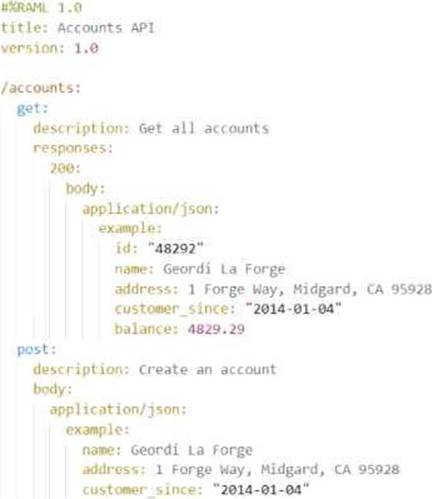
What data is expected by the POST /accounts endpoint?
A)
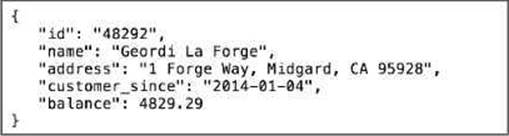
B)
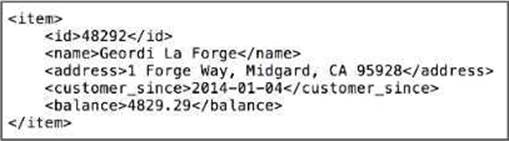
C)
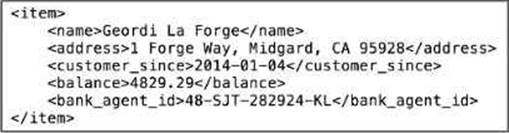
D)
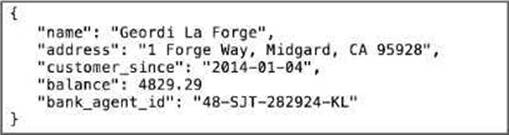
54. A REST connect module is generated for a RAML specification. and then the rest connect module is imported in mule application in Anypoint Studio.
For each method of the RAML specification, what does the REST connect module provide?
55. Refer to the exhibit.
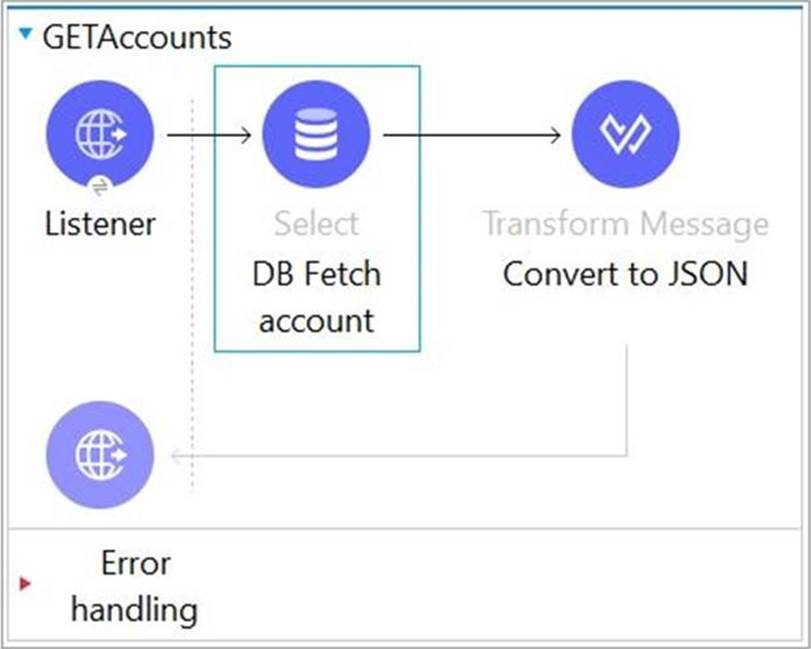
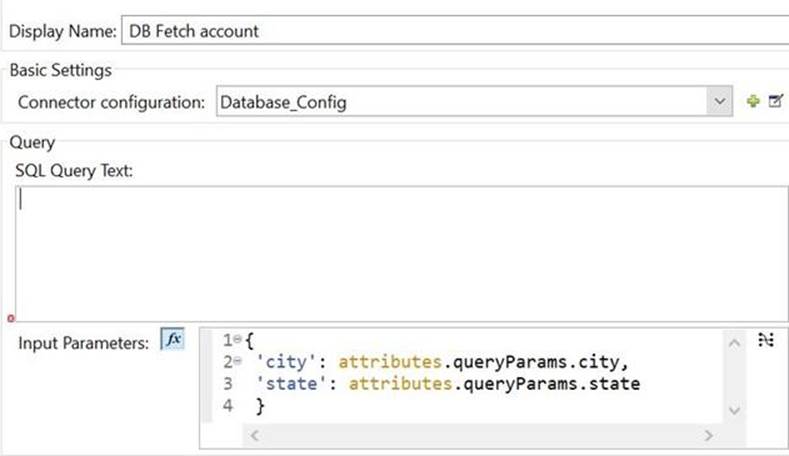
How should be the where clause written for the configured input parameters in such a way that it achieves below SQL query?
56. CORRECT TEXT
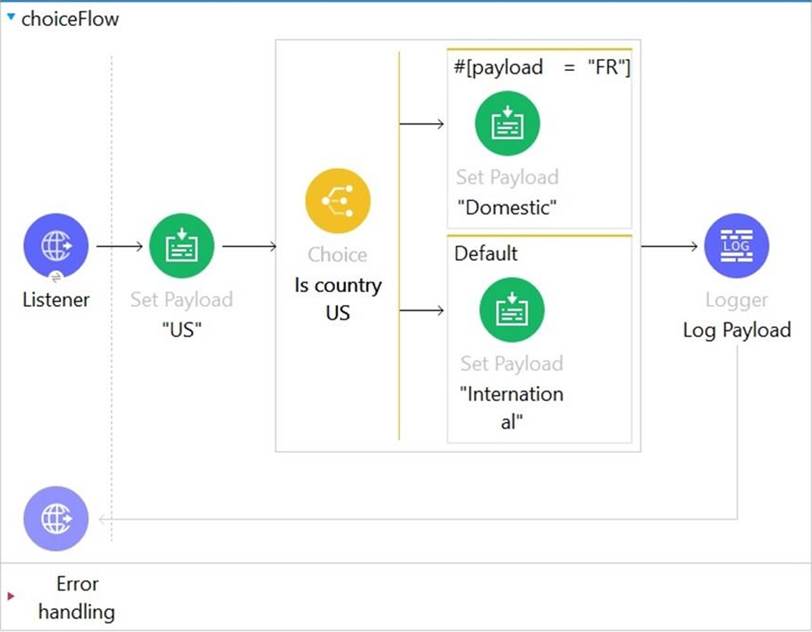
Refer to the exhibits. In the choice router, the When expression for the domestic shipping route is set to "#[payload= "FR"]".
What is the output of logger after the execution of choice router is completed?
57. Refer to the exhibits.
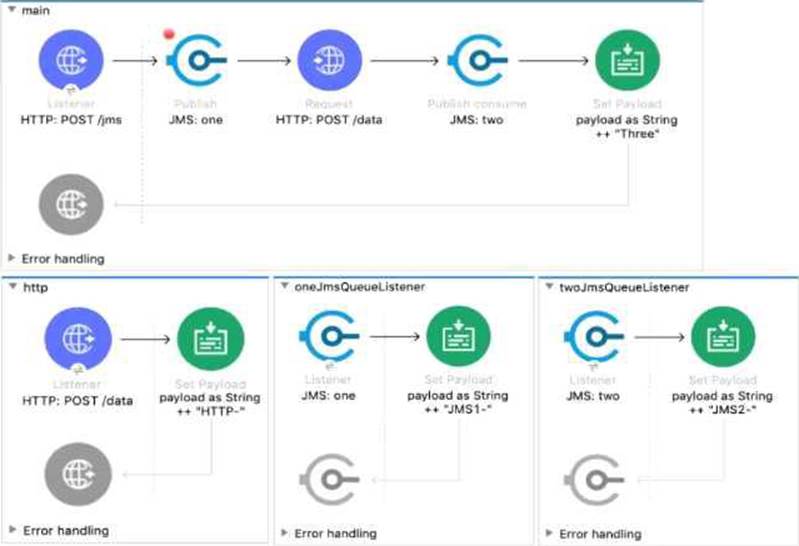
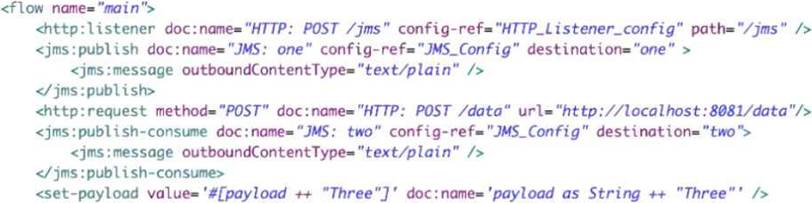
A web client sends a POST request to the HTTP Listener with the payload "Hello-" .
What response is returned to the web client?
58. As a part of project requirement, you want to build an API for a legacy client. Legacy client can only consume SOAP webservices .
Which type the interface documentation can be prepared to meet the requirement?
59. What should this endpoint return considering the API is build using standard practices?
http://dev.acme.com/api/patients?year=2021
60. A mule project contains MySQL database dependency. The project is exported from Anypoint Studio so that it can be deployed to Cloudhub .
What export options needs to be
selected to create the smallest deployable archive that will successfully deploy to Cloudhub?
61. A flow contains an HTTP Listener as the event source .
What is the DataWeave expression to log the Content-Type header using a Logger component?
62. Which out of below is not an asset?
63. Which of the below is not the mandatory configurations for HTTP Listener?
64. Where are values of query parameters stored in the Mule event by the HTTP Listener?
65. Refer to the exhibit.
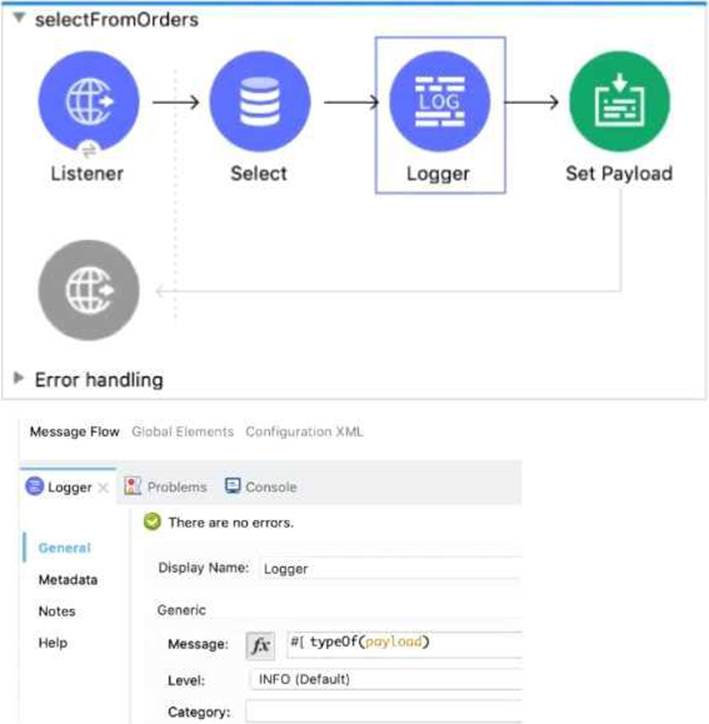
The Database Select operation returns five rows from a database .
What is logged by the Logger component?
66. How does APIkit determine the number of flows to generate from a RAML specification?
67. Refer to the exhibits.
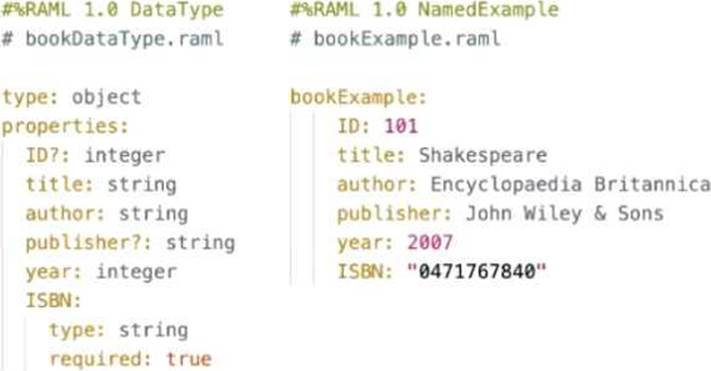
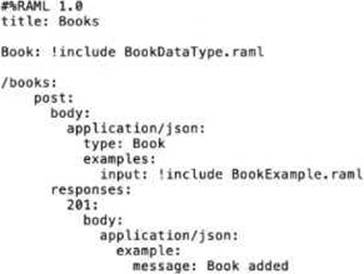
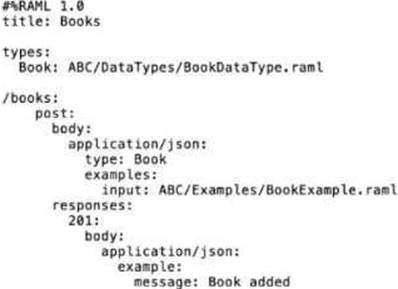
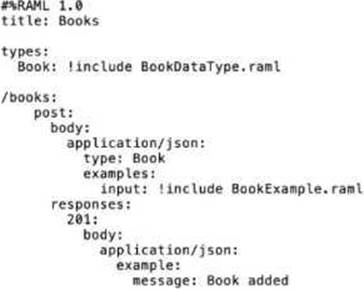
A company has defined this Book data type and Book example to be used in APIs .
What is valid RAML for an API that uses this Book data type and Book example?
A)
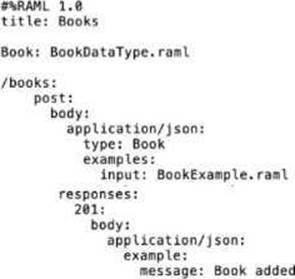
B)
C)
D)
68. Refer to the exhibit.
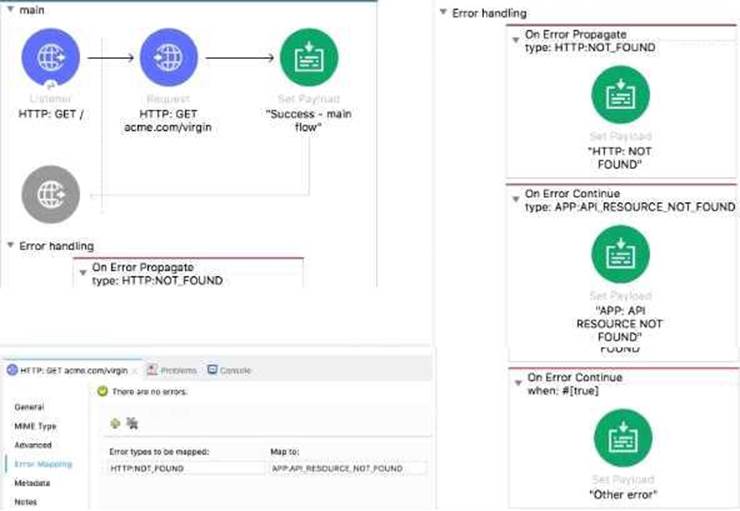
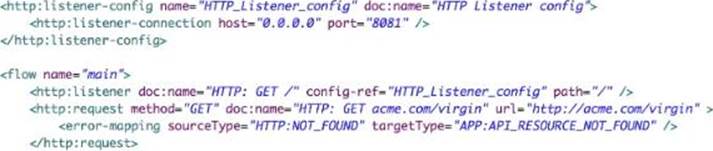
The main flow is configured with their error handlers. A web client submit a request to the HTTP Listener and the HTTP Request throws an HTTP:NOT_FOUND error.
What response message is returned?’’
What response message is returned?
69. Refer to the exhibits.
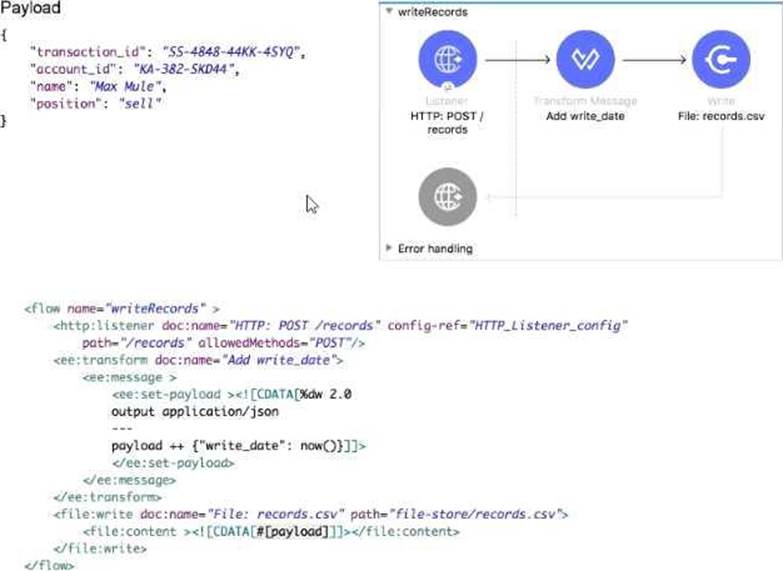
What is written to the records.csv file when the flow executes?
70. In an application network. If the implementation but not the interface of a product API changes, what needs to be done to the other APIs that consume the product API?
71. There are three routes configured for Scatter-Gather and incoming event has a payload is an Array of three objects .
How routing will take place in this scenario?
72. Refer to the exhibits.
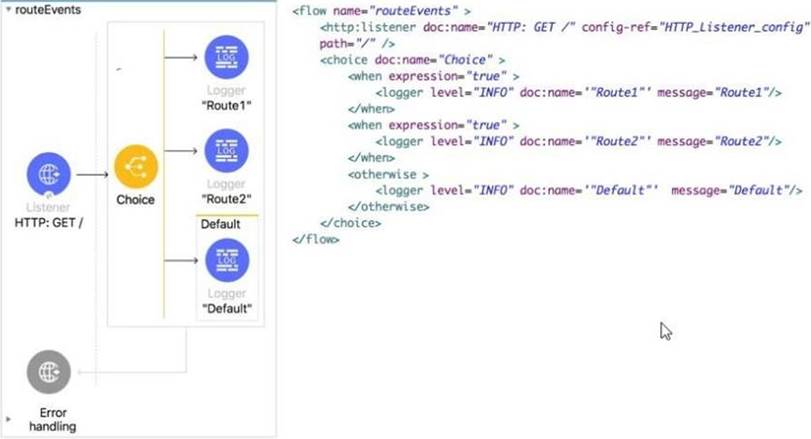
All three of the conditions for the Choice router are true .
What messages are written in the application log?
73. A Mule application contains a global error handler configured to catch any errors.
Where must the global error handler be specified so that the global error handler catches all errors from flows without their own error handlers?
Thanks for sharing a useful information..
ReplyDeleteBest Mulesoft Training
Mulesoft Online Training in Hyderabad